typed op• Datenarten: lightfield → image
• Aufruf: fullseye.apply(img, "tb_lf_epi_slope", a=0.5, b=0.5) (das 2-D-Modell ist ein Bild plus zwei skalare Regler a,b∈[0,1])
• GPU: ja (mechanischer GPU-Pfad aus der Allow-List, CuPy). device="auto" wählt die GPU ab der gemessenen Größe (589,824 Pixel)
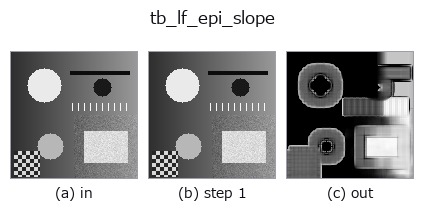
*Die Abbildung ist die tatsächliche Ausgabe auf einer synthetischen 128×128-Eingabe. Links Eingabe, rechts Ausgabe. Punktwolken als Draufsicht-Streudiagramm (Helligkeit = z), 1-D-Reihen als Linie, Volumen als Maximum-Projektion entlang z, Videos als mittleres Bild, komplexe Bilder als Betrag; Rückgabewerte, die kein Bild ergeben, werden als Werte gezeigt.*
*Regler a ändert die Ausgabe nicht (gemessen: identisch bei 0,1 / 0,5 / 0,9).*
*Regler b ändert die Ausgabe nicht (gemessen: identisch bei 0,1 / 0,5 / 0,9).*
Stufen (die vorangehenden Ops → dieser Op, von links nach rechts):
▸ tb_lf_epi_slope: Stufen (Doku-Website)
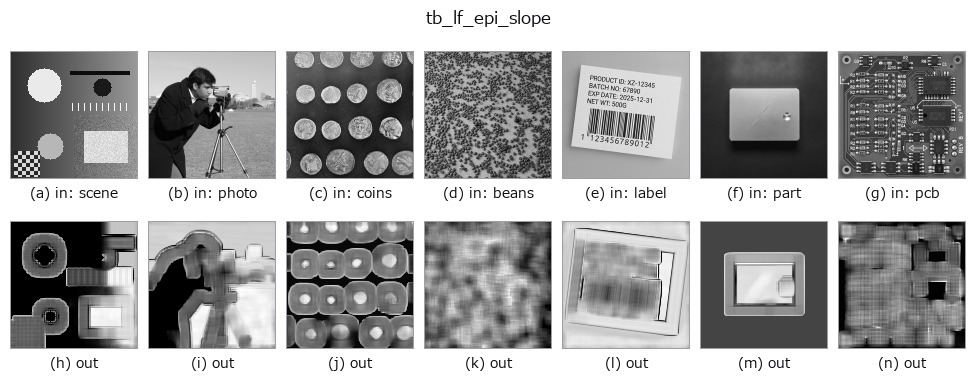
Auf anderen Bildern (synthetische Szene / Foto / Münzen. Obere Reihe: Eingaben, untere Reihe: deren Ausgaben. Regler auf Standard):
▸ tb_lf_epi_slope: andere Eingaben (Doku-Website)
Steigung pro Pixel aus der Orientierung der EPI-Linien (Strukturtensor, durch Scherung verfeinert).
> Die ausführliche Beschreibung unten ist der Originaltext — Zusammenfassung und Überschriften sind übersetzt.
A scene point traces a straight line in the epipolar-plane image (lf_epi), so along that line the intensity is constant:
E_u + s * E_x = 0. Accumulating that constraint over the whole angular grid and a window x window spatial neighbourhood gives the closed-form least-squares slope s = -(J_ux + J_vy) / (J_xx + J_yy) with J_ab = sum(E_a * E_b) — both the horizontal and vertical EPI directions pooled.
Why it is iterated (fixed 2026-11-03). A finite difference across views measures a displacement of s px per view, while a finite difference across pixels measures one of 1 px; for a texture component of angular frequency w the ratio is sin(w s) / sin(w) (the pre-fix central differences), equal to s only at |s| in {0, 1}. That is the classic statement that the structure tensor is accurate only for disparities in a small range around zero (Wanner & Goldluecke, CVPR 2012 and TPAMI 36(3) 2014, who handle larger ranges by shearing the light field). So the estimator shears the field by an integer slope k (integer shifts: no resampling blur), measures the residual r = s - k, sets k <- round(k + r) per pixel and repeats until no pixel changes (at most EPI_MAX_ROUNDS rounds, at most EPI_MAX_SHEARS distinct shears). The residual is measured with a matched discretisation (adjacent-view difference against the mean of the two views' Gaussian derivatives, inner scale EPI_INNER_SIGMA), whose error is O(r^3 w^2) with |r| <= 1/2.
Measured 2026-11-03, median over the interior of single-layer lf_synthesize fields (64x64, edge="wrap"), s in [-3, 3] in steps of 0.25: error <= 0.006 px for 5x5 and 9x9 views, <= 0.007 px for 4x4 (even count) and <= 0.012 px for 3x3 and for a single row of 6 views, at texture sigma 1.0 / 1.5 / 2.0 / 5.0 px, for windows 5 / 9 / 15 (the pre-fix estimator read -1.388 for -1.5 at sigma 2 and 1.46 for 2.0 at sigma 1.5). Integer slopes are exact to 1e-9 on a wrapped field. Valid range: the shear ladder starts at k = 0, so the first pass must see the right sign and a non-vanishing magnitude: that holds for |s| <= 3 at any texture correlation length >= 1 px, and (measured) up to |s| = 8 at sigma >= 2; at sigma 1 it fails beyond |s| = 5 (s = 6 read as 0.25 — the texture is aliased: it moves more than its correlation length several times per view). Near an occlusion boundary the window mixes two slopes (no estimator of a single orientation per window can avoid that). With edge="nearest" input the outer |k|*(N-1)/2 px of the frame see clamped border pixels.
Returns (slope_map, energy): the (H, W) slope map (centre-view coordinates) and the (H, W) gradient energy J_xx + J_yy of the unsheared field (the first pass's denominator). Pixels whose energy is below *min_energy* have no measurable parallax (a flat patch of sky); their slope is set to 0 and their energy reported as-is, so you threshold on energy instead of being handed a plausible-looking number divided by ~0.
Raises ValueError: *lf* not a valid light field, an angular/spatial shape where *neither* EPI direction carries information (the horizontal EPI needs U >= 2 and W >= 2, the vertical needs V >= 2 and H >= 2), an even or non-positive *window*, a non-positive *min_energy*.
Typed bridge of the lightfield op lf_epi_slope into the 2-D evolution registry: the same implementation, called under the op(v, a, b) convention. This op has no tunable parameter; a and b are unused.
• Katalog der Beispieldaten (Download-URLs / Lizenzen) — 2-D nutzt skimage.data (BSD/Public Domain) plus synthetische Bilder, 3-D nennt Download-URLs echter Datenquellen (Stanford, PDS, …).
• Herkunft und Literatur der Operatoren — die Quellen der Forschung/Verfahren, auf denen diese Operatorfamilie beruht.
Das Programm unten ist nachweislich lauffähig (gleiche Eingabe wie die Abbildung). In der Studio-Hilfe wird dieser Block zu Schaltflächen, die es sofort laden und ausführen.
img_to_lightfield 0.50 0.50
tb_lf_epi_slope 0.50 0.50
▸ Diese Pipeline laden · Laden & ausführen
Die folgenden Beispiele rufen den zugrunde liegenden Ledger-Op lf_epi_slope auf. Dieser Brücken-Op ist dieselbe Implementierung, angepasst an die Konvention fn(v, a, b); das Verhalten gilt unverändert (nur die Aufrufform unterscheidet sich).
• lightfield_depth — py -3.11 examples/lightfield_depth.py
• poc_lightfield_depth — py -3.11 examples/poc_lightfield_depth.py
image als Eingabe)identity · gaussian · mean_box · mean_box_wh · bilateral · kuwahara · unsharp · median
typed)tb_points_to_voxel · tb_estimate_point_normals · tb_iss_keypoints · tb_project_points · tb_render_point_depth · tb_points_render · tb_statistical_outlier_removal · tb_radius_outlier_removal
*Provenance: ops.py — 2D Operator-Registry. Diese Notiz wird von tools/opdocs.py md erzeugt (nicht von Hand bearbeiten).*
© 2026 Kazufumi Furuse — Fullseye operator documentation. Licensed under Apache-2.0.