Means, Aggregation functions...
Documentation:
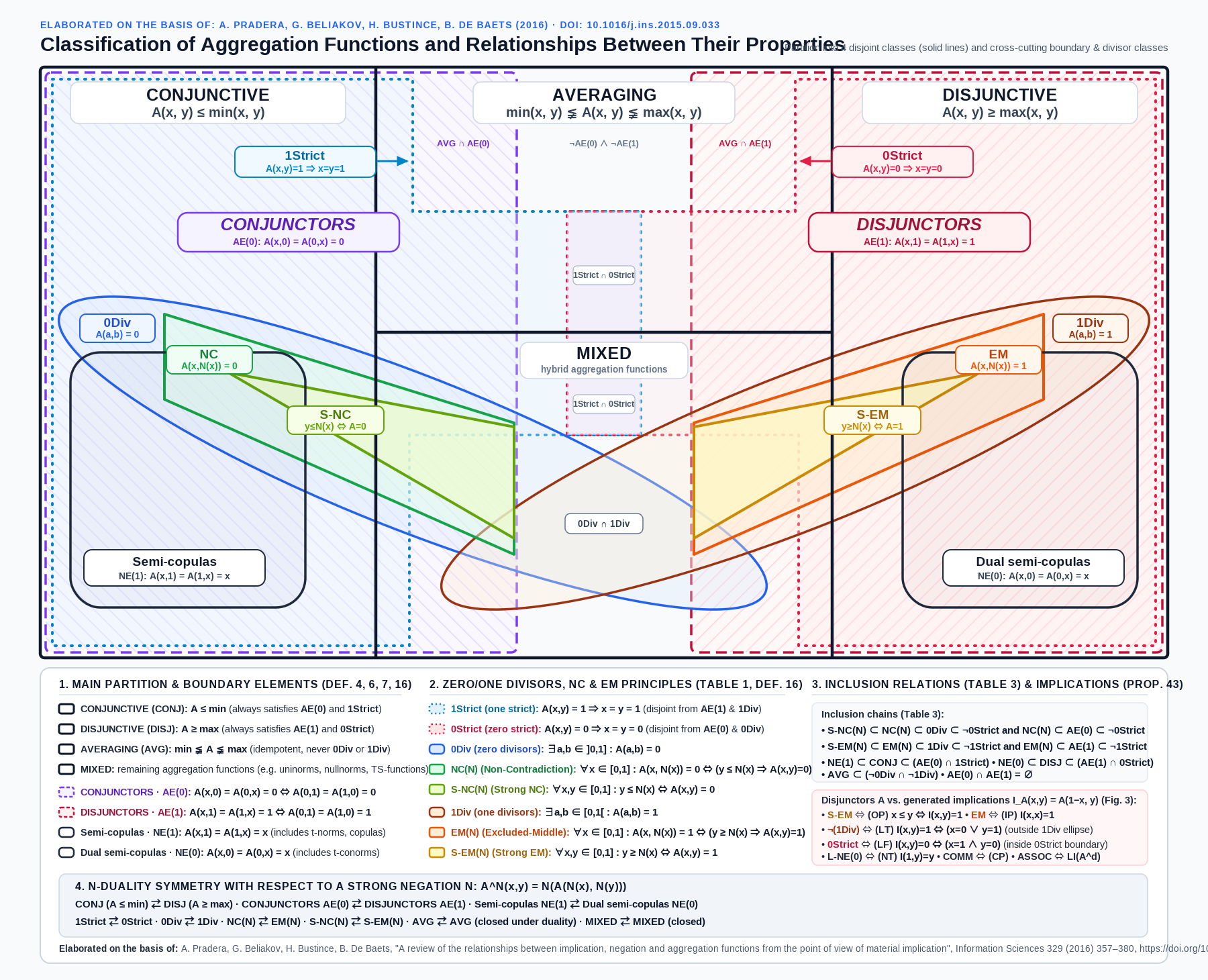
Aggregation functions can be classified in several ways. A familiar distinction is between three types of behaviour:
These are not the only possibilities: aggregation functions can also exhibit mixed behaviour. The diagram below presents a broader classification.
Diagram elaborated on the basis of: A. Pradera, G. Beliakov, H. Bustince, B. De Baets, "A review of the relationships between implication, negation and aggregation functions from the point of view of material implication", Information Sciences 329 (2016) 357–380, DOI: 10.1016/j.ins.2015.09.033.
An interactive version of this diagram is available at: https://wgalka.github.io/Means/aggregation_classification.html
# example data
data = [0.2, 0.6, 0.7]
# configure function parameters
func1 = A_amn(p=0.5)
# use aggregation funciton
print(func1(data))

# Combine two aggregations - arithmetic mean and minimum
func2 = Combine2Aggregations(A_ar(), min)
# use combination of aggregation funciton
print(func2(data))To get information about aggregation function you can use
__str__() or 'repr()' methods.
func1 = A_amn(p=0.5)
print(func1)
>>>A_amn(0.5)

func2 = Combine2Aggregations(A_ar(), A_md())
print(func2)
>>>A_armd

func3 = Combine2Aggregations(A_ar(), A_pw(r=3))
print(func3.__repr__()) # function parameters are printed in order: func1, func2
>>>A_arpw(r=3)aggregationslib.ndarray provides the same
A_... objects as aggregationslib.aggregations,
with additional constructor options axis and
keepdims. It applies the existing vector implementation
separately to each vector along the selected axis.
import numpy as np
from aggregationslib.ndarray import A_ar, A_ch
from aggregationslib import weighted_measure

X = np.array([[0.2, 0.6, 0.9], [0.9, 0.2, 0.6]])
A_ar(axis=1)(X)                 # shape (2,): one value per row
A_ar(axis=0)(X)                 # shape (3,): one value per column
A_ar(axis=1, keepdims=True)(X)  # shape (2, 1)
A_ar()(X)                      # scalar: aggregate all elements

mu = weighted_measure([0.5, 0.3, 0.2])
A_ch(measure=mu, axis=-1)(X)    # array([0.46, 0.63])
axis=None (the default) flattens the input in C order.
An integer axis, including a negative index, reduces that axis; tuples
of axes are not supported. For an input of shape (m, n),
axis=1 returns shape (m,), including
(1,) when there is just one row. keepdims=True
retains reduced dimensions with length one. A complete reduction returns
a scalar unless keepdims=True.
Choquet and Sugeno use the same measure for each vector. Its size
must match the selected axis length, or the total element count for
axis=None. Choquet's quasi_overlap continues
to accept scalar callbacks. Combine2Aggregations accepts
vector callables or objects from this module; the combination's own
axis and keepdims control the reduction.
Empty vectors are rejected. An empty batch of nonempty vectors returns an empty floating-point array of the appropriate shape. The mathematical domains, parameter rules and numerical behavior are inherited from the vector implementations. This module uses iteration over vectors, not vectorized implementations of the aggregation formulas.
An aggregation function on the unit interval [1] is an increasing mapping A : [0, 1]n → [0, 1], n ∈ ℕ, n ≥ 2, satisfying A(0, …, 0) = 0 and A(1, …, 1) = 1. For inputs on another interval [a, b] ⊂ ℝ, an [a, b]-aggregation is an increasing mapping A : [a, b]n → [a, b] satisfying A(a, …, a) = a and A(b, …, b) = b.
The following aggregation functions are implemented in this library.
Tags describe properties of each formula. averaging means
the result lies between the minimum and maximum inputs;
conjunctive means it does not exceed the minimum;
symmetric means permuting the inputs does not change the
result. aggregation interval states the intervals on which
the formula is an aggregation function: an increasing map A : [a, b]n → [a, b]
satisfying A(a, …, a) = a
and A(b, …, b) = b.
any [a,b] ⊂ ℝ includes intervals with negative values;
any [a,b] ⊆ [0,∞) is restricted to nonnegative intervals.
[0,1] means only the unit interval. These are mathematical
properties; most callable objects do not validate input bounds at
runtime. Some tags depend on parameters or the fuzzy measure.
Ach(μ) - Discrete Choquet integral [1]
Tags: averaging aggregation interval: [0,1]
symmetric if μ is symmetric
For an input vector (x1, …, xn) ∈ [0, 1]n, let σ sort its indices so that xσ(1) ≤ … ≤ xσ(n). Define Aσ(i) = {σ(i), …, σ(n)} and xσ(0) = 0:
$$A_{ch}^{(\mu)}(x_1,\dots,x_n)=\sum_{i=1}^{n}(x_{\sigma(i)}-x_{\sigma(i-1)})\,\mu(A_{\sigma(i)})$$
Available fuzzy measures for the Choquet integral:
Each constructor returns a monotone fuzzy measure with μ(∅) = 0 and μ(N) = 1.
uniform_measure(n)): μ(A) = |A|/n;
every position has equal singleton weight.relative_measure(n)): $\mu(A)=\frac{\sum_{i\in
A}i}{\sum_{j=1}^{n}j}$; singleton weights are proportional to
1, 2, ..., n, so later positions receive larger
weights.k_fuzzy_measure(weights)): for k ≠ 0, $\mu(A)=\frac{\prod_{i\in A}(1+k w_i)-1}{k}$;
for k = 0, μ(A) = ∑i ∈ Awi.
The parameter k is chosen so μ(N) = 1; incompatible
singleton weights raise ValueError.weighted_measure(weights)): μ(A) = ∑i ∈ Awi.
The weights must be in [0, 1] and sum to 1;
with the Choquet integral this gives a weighted arithmetic mean.owa_measure(weights)): $\mu(A)=\sum_{j=1}^{|A|}w_j$. The normalized
weights are applied by descending value rank, so the first belongs to
the largest value; with the Choquet integral this capacity gives the OWA
aggregation.exponential_cardinality_measure(n, q=1)): μ(A) = (|A|/n)q,
where q must be finite and q > 0. For q = 1, this is the
uniform/cardinality measure, and the discrete Choquet integral equals
the arithmetic mean.The constructors are in aggregationslib.aggregation;
Decimal equivalents are available in
aggregationslib.decimalaggregations.
With the default cardinality measure μ(A) = |A|/n, this is the arithmetic mean, $A_{ch}^{(\mu)}(x_1,\dots,x_n)=\frac{1}{n}\sum_{i=1}^{n}x_i$.
For the quasi-overlap generalization from Equation (9), pass a
two-argument function O(x, mu) as
quasi_overlap to choquet_integral or
A_ch. The default remains the classical product-based
Choquet integral.
Asg(μ) - Discrete Sugeno integral [1]
Tags: averaging aggregation interval: [0,1]
symmetric if μ is symmetric
For an input vector (x1, …, xn) ∈ [0, 1]n, let σ sort its indices so that xσ(1) ≤ … ≤ xσ(n), and define Aσ(i) = {σ(i), …, σ(n)}:
Asg(μ)(x1, …, xn) = max1 ≤ i ≤ nmin (xσ(i), μ(Aσ(i)))
Available fuzzy measures for the Sugeno integral:
Each constructor returns a monotone fuzzy measure with μ(∅) = 0 and μ(N) = 1. The same
constructors are available in aggregationslib.aggregation
and aggregationslib.decimalaggregations.
uniform_measure(n)): μ(A) = |A|/n;
every position has equal singleton weight.relative_measure(n)): $\mu(A)=\frac{\sum_{i\in
A}i}{\sum_{j=1}^{n}j}$; singleton weights are proportional to
1, 2, ..., n, so later positions receive larger
weights.k_fuzzy_measure(weights)): for k ≠ 0, $\mu(A)=\frac{\prod_{i\in A}(1+k w_i)-1}{k}$;
for k = 0, μ(A) = ∑i ∈ Awi.
The parameter k is chosen so μ(N) = 1; incompatible
singleton weights raise ValueError.weighted_measure(weights)): μ(A) = ∑i ∈ Awi.
The weights must be in [0, 1] and sum to 1. In
the Sugeno integral this measure is used in the max–min formula; it does
not turn Sugeno into a weighted arithmetic mean.owa_measure(weights)): $\mu(A)=\sum_{j=1}^{|A|}w_j$. The normalized
weights are applied by descending value rank, so the first belongs to
the largest value. In the Sugeno integral this capacity is used in the
max–min formula; the result is not the OWA aggregation.exponential_cardinality_measure(n, q=1)): μ(A) = (|A|/n)q,
where q must be finite and q > 0. For q = 1, this is the
uniform/cardinality measure.Aar - Arithmetic mean
Tags: averaging symmetric
aggregation interval: any [a,b] ⊂ ℝ
$$A_{ar}(x_1,...,x_n)=\frac{1}{n}\sum \limits_{k=1}^{n} x_k$$
Aqd - Quadratic mean
Tags: averaging symmetric
aggregation interval: any [a,b] ⊆ [0,∞)
$$A_{qd}(x_1,...,x_n)=\sqrt{\frac{1}{n}\sum \limits_{k=1}^{n} x_k^2}$$
Apr - Product aggregation
Tags: conjunctive symmetric
aggregation interval: [0,1]
$$A_{pr}(x_1, x_2, \dots, x_n) = \prod_{k=1}^n x_k$$
Agm - Geometric mean
Tags: averaging symmetric
aggregation interval: any [a,b] ⊆ [0,∞)
$$A_{gm}(x_1,...,x_n)=\sqrt[n]{\prod \limits_{k=1}^{n} x_k}$$
Ahm - Harmonic mean
Tags: averaging symmetric
aggregation interval: any [a,b] ⊆ [0,∞)
$$ A_{hm}(x_1,...,x_n) = \begin{cases} 0, & \text{if } \exists k,\, 1 \leq k \leq n : x_k = 0 \\ \frac{n}{\sum\limits_{k=1}^{n} \frac{1}{x_k}}, & \text{otherwise} \end{cases} $$
Apw(r) - Power mean
Tags: averaging symmetric
aggregation interval: any [a,b] ⊆ [0,∞)
r ≠ 0
$$ A_{pw}^{(r)}(x_1,...,x_n) = \begin{cases} 0, & r < 0, \; \exists k,\, 1 \leq k \leq n : x_k = 0 \\ \Big(\frac{1}{n} \sum\limits_{k=1}^{n} x_k^r \Big)^{\frac{1}{r}}, & \text{otherwise} \end{cases} $$
special cases of power means Apwr [1] are:
Aex(r) - Exponential mean
Tags: averaging symmetric
aggregation interval: any [a,b] ⊂ ℝ r ≠ 0
$$A_{ex}^{(r)}(x_1,...,x_n)= \frac{1}{r}\ln \Big(\frac{1}{n} \sum \limits_{k=1}^{n} e^{rx_k}\Big), \text{where } r \in \mathbb{R}, r \neq 0$$
For computer implementations, to avoid numerical instability (overflow when rxk > 709.78 or underflow when all rxk < −709.78), we use a numerically stable Log-Sum-Exp formulation by shifting the exponents by amax = maxj(rxj):
$$A_{ex}^{(r)}(x_1,...,x_n) = \frac{1}{r} \left[ a_{max} + \ln \left( \sum_{i=1}^n e^{r x_i - a_{max}} \right) - \ln(n) \right]$$
Alm - Lehmer mean
Tags: averaging symmetric
aggregation interval: any [a,b] ⊆ [0,∞) if 0 ≤ r ≤ 1
$$A_{lm}(x_1,...,x_n)= \begin{cases} 0, & r\leq 1, \exists_{1 \leq k \leq n} x^{k} = 0 \\ \frac{\sum \limits_{k=1}^{n}x_k^r}{\sum \limits_{k=1}^{n}x_k^{r-1}}, & \text{otherwise} \end{cases}$$
Aamn(p) - Arithmetic minimum mean
Tags: averaging symmetric
conjunctive if p = 0
aggregation interval: any [a,b] ⊂ ℝ
p ∈ [0,1]
$$A_{amn}^{(p)}(x_1,...,x_n)=\frac{p}{n}\sum \limits_{k=1}^{n} x_k+ (1-p) \min \limits_{1 \leq k \leq n}x_k, p \in [0, 1]$$
Aamx(p) - Arithmetic maximum mean
Tags: averaging symmetric
disjunctive if p = 0
aggregation interval: any [a,b] ⊂ ℝ
p ∈ [0,1]
$$A_{amx}^{(p)}(x_1,...,x_n)=\frac{p}{n}\sum \limits_{k=1}^{n} x_k+ (1-p) \max \limits_{1\leq k \leq n}x_k, p \in [0, 1]$$
In the case of n = 2 (when only two values are aggregated) the calculation of the median and the Olympic aggregation are reduced to the case of calculating the arithmetic mean of the given values.
Amd - Median - ordered weighted aggregation
Tags: averaging symmetric
aggregation interval: any [a,b] ⊂ ℝ
$$A_{md}(x_1,\dots,x_n) = \begin{cases} y_{(n+1)/2},&\text{if $n$ is odd}\\ \frac{y_{n/2}+y_{(n/2)+1}}{2},&\text{if $n$ is even} \end{cases},$$
Aol - Olimpic aggregation
Tags: averaging symmetric
aggregation interval: any [a,b] ⊂ ℝ
$$ A_{ol}(x_1,\dots,x_n) = \frac{1}{n-2} \sum \limits_{k=2}^{n-1} y_k, \quad \text{where } \{y_1, \dots, y_n\} = \{x_1, \dots, x_n\},\ y_1 \leq y_2 \leq \dots \leq y_n.$$
Aoln(p) - Olimpic aggregation
Tags: averaging symmetric
aggregation interval: any [a,b] ⊂ ℝ
p ∈ ℕ, p ≥ 1
We can specify how many greatest and smallest records remove
$$ A_{oln}^{(p)}(x_1,\dots,x_n) = \frac{1}{n-2p} \sum \limits_{k=p+1}^{n-p} y_k, \quad \text{where } \{y_1, \dots, y_n\} = \{x_1, \dots, x_n\},\ y_1 \leq y_2 \leq \dots \leq y_n, p \in \mathbb{N}, p\geq 1$$
Aln - Logaritmic aggregation [2]
Tags: averaging (continuous formula)
symmetric
aggregation interval (after continuous extension): any [a,b] ⊂ (0,∞)
$$ A_{ln}\left(x_1, x_2, \ldots, x_n\right)=(n-1) ! \sum_{i=1}^n \frac{x_i}{\prod_{\substack{j=1 \\ j \neq i}}^n \log \left(x_i / x_j\right)} $$
The formula has a continuous averaging extension when input values
coincide, but the current implementation does not handle ties: a zero
denominator makes it return 0.
Tags: aggregation interval: common interval of A₁ and A₂
averaging if both inputs are averaging
p ∈ [0,1]
We can construct covex combination of aggregation functions as AA1, A2(p) = pA1 + (1 − p)A2, where A1, A2 are aggregation functions and p ∈ [0, 1].
A local interface lets you upload a CSV table, select columns and an
aggregation, add input vectors, and download row-wise results. It also
generates the equivalent Python code using
aggregationslib.ndarray. See setup
and usage.