typed op• Data kinds: lightfield → image
• Call: fullseye.apply(img, "tb_lf_epi_slope", a=0.5, b=0.5) (2-D model = एक image + दो scalar knobs a,b∈[0,1])
• GPU: नहीं (केवल CPU reference implementation)
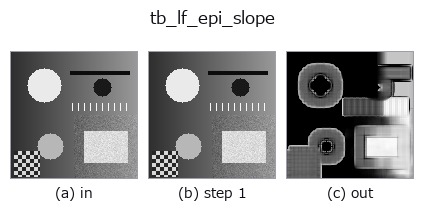
*Figure synthetic 128×128 input पर सच में चलाकर मिला output है। बाईं ओर input, दाईं ओर output। Point clouds ऊपर से देखे गए scatter के रूप में (brightness = z), 1-D series line के रूप में, volumes z दिशा में maximum-intensity projection के रूप में, videos बीच के frame के रूप में, complex images amplitude के रूप में, और जो return values चित्र नहीं बन सकते वे स्वयं values के रूप में दिखाए जाते हैं।*
*Knob a output नहीं बदलता (मापा गया: 0.1 / 0.5 / 0.9 पर एक जैसा)।*
*Knob b output नहीं बदलता (मापा गया: 0.1 / 0.5 / 0.9 पर एक जैसा)।*
Stages (पहले आने वाले ops → यह op, बाएँ से क्रम में):
▸ tb_lf_epi_slope: stages का figure (docs site)
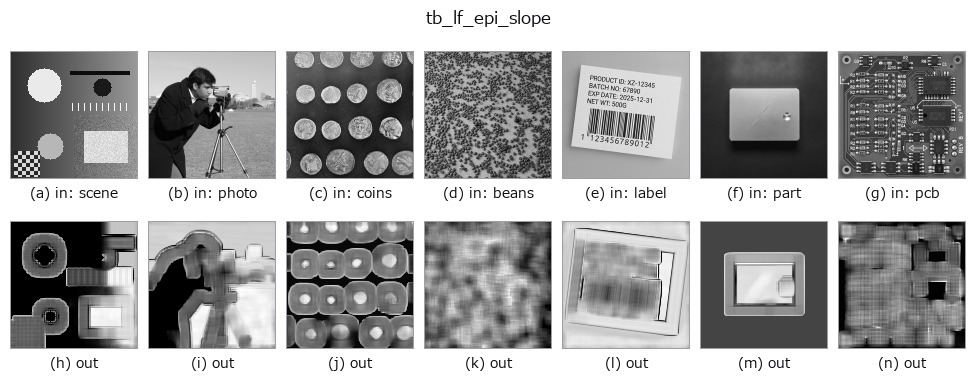
दूसरी images पर भी (synthetic scene / photo / coins। ऊपर की row में inputs, नीचे की row में उनके outputs। Knobs default पर):
▸ tb_lf_epi_slope: दूसरी images पर output (docs site)
EPI line की दिशा से हर pixel का slope निकालता है (structure tensor, shearing से परिष्कृत)।
> नीचे का विस्तृत विवरण मूल text में है — सारांश और headings का अनुवाद हो चुका है।
A scene point traces a straight line in the epipolar-plane image (lf_epi), so along that line the intensity is constant:
E_u + s * E_x = 0. Accumulating that constraint over the whole angular grid and a window x window spatial neighbourhood gives the closed-form least-squares slope s = -(J_ux + J_vy) / (J_xx + J_yy) with J_ab = sum(E_a * E_b) — both the horizontal and vertical EPI directions pooled.
Why it is iterated (fixed 2026-11-03). A finite difference across views measures a displacement of s px per view, while a finite difference across pixels measures one of 1 px; for a texture component of angular frequency w the ratio is sin(w s) / sin(w) (the pre-fix central differences), equal to s only at |s| in {0, 1}. That is the classic statement that the structure tensor is accurate only for disparities in a small range around zero (Wanner & Goldluecke, CVPR 2012 and TPAMI 36(3) 2014, who handle larger ranges by shearing the light field). So the estimator shears the field by an integer slope k (integer shifts: no resampling blur), measures the residual r = s - k, sets k <- round(k + r) per pixel and repeats until no pixel changes (at most EPI_MAX_ROUNDS rounds, at most EPI_MAX_SHEARS distinct shears). The residual is measured with a matched discretisation (adjacent-view difference against the mean of the two views' Gaussian derivatives, inner scale EPI_INNER_SIGMA), whose error is O(r^3 w^2) with |r| <= 1/2.
Measured 2026-11-03, median over the interior of single-layer lf_synthesize fields (64x64, edge="wrap"), s in [-3, 3] in steps of 0.25: error <= 0.006 px for 5x5 and 9x9 views, <= 0.007 px for 4x4 (even count) and <= 0.012 px for 3x3 and for a single row of 6 views, at texture sigma 1.0 / 1.5 / 2.0 / 5.0 px, for windows 5 / 9 / 15 (the pre-fix estimator read -1.388 for -1.5 at sigma 2 and 1.46 for 2.0 at sigma 1.5). Integer slopes are exact to 1e-9 on a wrapped field. Valid range: the shear ladder starts at k = 0, so the first pass must see the right sign and a non-vanishing magnitude: that holds for |s| <= 3 at any texture correlation length >= 1 px, and (measured) up to |s| = 8 at sigma >= 2; at sigma 1 it fails beyond |s| = 5 (s = 6 read as 0.25 — the texture is aliased: it moves more than its correlation length several times per view). Near an occlusion boundary the window mixes two slopes (no estimator of a single orientation per window can avoid that). With edge="nearest" input the outer |k|*(N-1)/2 px of the frame see clamped border pixels.
Returns (slope_map, energy): the (H, W) slope map (centre-view coordinates) and the (H, W) gradient energy J_xx + J_yy of the unsheared field (the first pass's denominator). Pixels whose energy is below *min_energy* have no measurable parallax (a flat patch of sky); their slope is set to 0 and their energy reported as-is, so you threshold on energy instead of being handed a plausible-looking number divided by ~0.
Raises ValueError: *lf* not a valid light field, an angular/spatial shape where *neither* EPI direction carries information (the horizontal EPI needs U >= 2 and W >= 2, the vertical needs V >= 2 and H >= 2), an even or non-positive *window*, a non-positive *min_energy*.
Typed bridge of the lightfield op lf_epi_slope into the 2-D evolution registry: the same implementation, called under the op(v, a, b) convention. This op has no tunable parameter; a and b are unused.
• Sample data catalog (DL URL / license) — 2-D के लिए skimage.data (BSD/public) + synthetic, 3-D के लिए real data sources (Stanford/PDS आदि) के DL URL।
• Operators का स्रोत और संदर्भ — इस op family के मूल research/methods के स्रोत।
नीचे का program सच में चलता है, यह जाँचा गया है (figure वाला ही input)। Studio की help में यह block buttons बन जाता है, जिनसे इसे वहीं load करके चलाया जा सकता है।
img_to_lightfield 0.50 0.50
tb_lf_epi_slope 0.50 0.50
▸ यह pipeline load करें · Load करके चलाएँ
नीचे के उदाहरण मूल ledger op lf_epi_slope को call करते हैं। यह bridge op वही implementation है, बस fn(v, a, b) convention के अनुसार ढाला गया है, इसलिए व्यवहार वैसा ही लागू होता है (केवल call का रूप अलग है)।
• lightfield_depth — py -3.11 examples/lightfield_depth.py
• poc_lightfield_depth — py -3.11 examples/poc_lightfield_depth.py
image को input के रूप में लेते हैं)identity · gaussian · mean_box · mean_box_wh · bilateral · kuwahara · unsharp · median
typed)tb_points_to_voxel · tb_estimate_point_normals · tb_iss_keypoints · tb_project_points · tb_render_point_depth · tb_points_render · tb_statistical_outlier_removal · tb_radius_outlier_removal
*Provenance: ops.py — 2D operator registry. यह per-op note tools/opdocs.py md से अपने-आप generate होता है (हाथ से edit न करें)।*
© 2026 Kazufumi Furuse — Fullseye operator documentation. Licensed under Apache-2.0.